Death &
Memory
in the works of Cai Guo-Qiang
Words by Ritty Tacsum
Visuals by Tony Hisgett, Norman Tsai, Diego Berruegos
To talk at all interestingly about death is inevitably to talk about life. (Enright; 1983)
Death is a highly explored theme, and one can only speculate as to the many reasons why artists would choose to represent the expiration of life rather than the celebration of it. And just perhaps, memory is the answer. Freud states that our mind represses thoughts and memories that we no longer use. It doesn’t delete anything. By portraying death, are such artists attempting to prolong life or to bring such memories to life? Does an image give life legacy? Is it a symbol of lastingness, longevity, and endurance?
Cai Guo-Qiang’s installation works are huge and breathtaking, one could also debate that they verge on the sublime. One does not immediately associate the works with death upon experiencing them. They are dynamic installations, which, to a certain extent, were created to mesmerise their audience. His works – whether those utilising the medium of gunpowder, fireworks or objects have no sudden association to death and neither are their underlying connotations incredibly overt.
The birth of the reader must be at the cost of the death of the Author. (Barthes, 1967)
To speak about Cai Guo-Qiang’s work, one cannot help but make an association with or draw from the writings of Barthes, specifically his essay titled The Death of the Author (1967). In this critical essay, Barthes addresses the power of the author in creating a work of art and the power of the viewer when analysing the same work without attributing due consideration to the author.
With this theory in mind, one cannot help but associate it with the way we interpret Guo-Yang’s work. On a superficial level, his works are visually pleasing; highly aesthetic. The general comments from the audience revolve around the artworks’ aesthetic properties whilst the underlying meaning or concept often remains ignored. The viewer is presented with such an overwhelming image that the true meaning behind the work can often be neglected, if not completely discarded.
If the artist’s intentions are ignored, then so are his motifs – the author becomes irrelevant as the artwork dominates the viewer. One has to read such works thoroughly if they are to fully understand where Guo-Yang is coming from and what he is trying to represent.
Cai Guo-Qiang was born in 1957 in Quanzhou, China. As a child, Cai witnessed the social effects of the Cultural Revolution first-hand, actively participating in demonstrations and parades. He grew up in an environment where explosions were commonplace irrespective of whether they were the result of cannon blasts or celebratory fireworks. He also witnessed the ‘use’ of gunpowder in both negative and positive ways. Throughout his career, Cai channeled such experiences and memories through his numerous gunpowder drawings and installations. Cai Guo-Yang is preoccupied with the concept of temporality in the works of art – most of his creations are not meant to last a lifetime; on the contrary, on the subject he states that:
Temporality in art is also about the universal problem facing the all-too-mortal artist in conceiving and executing a mark on the world that will be remembered throughout history. This temporal perspective can be daunting, especially as it relates to the human life span. (Cameron, 2006)
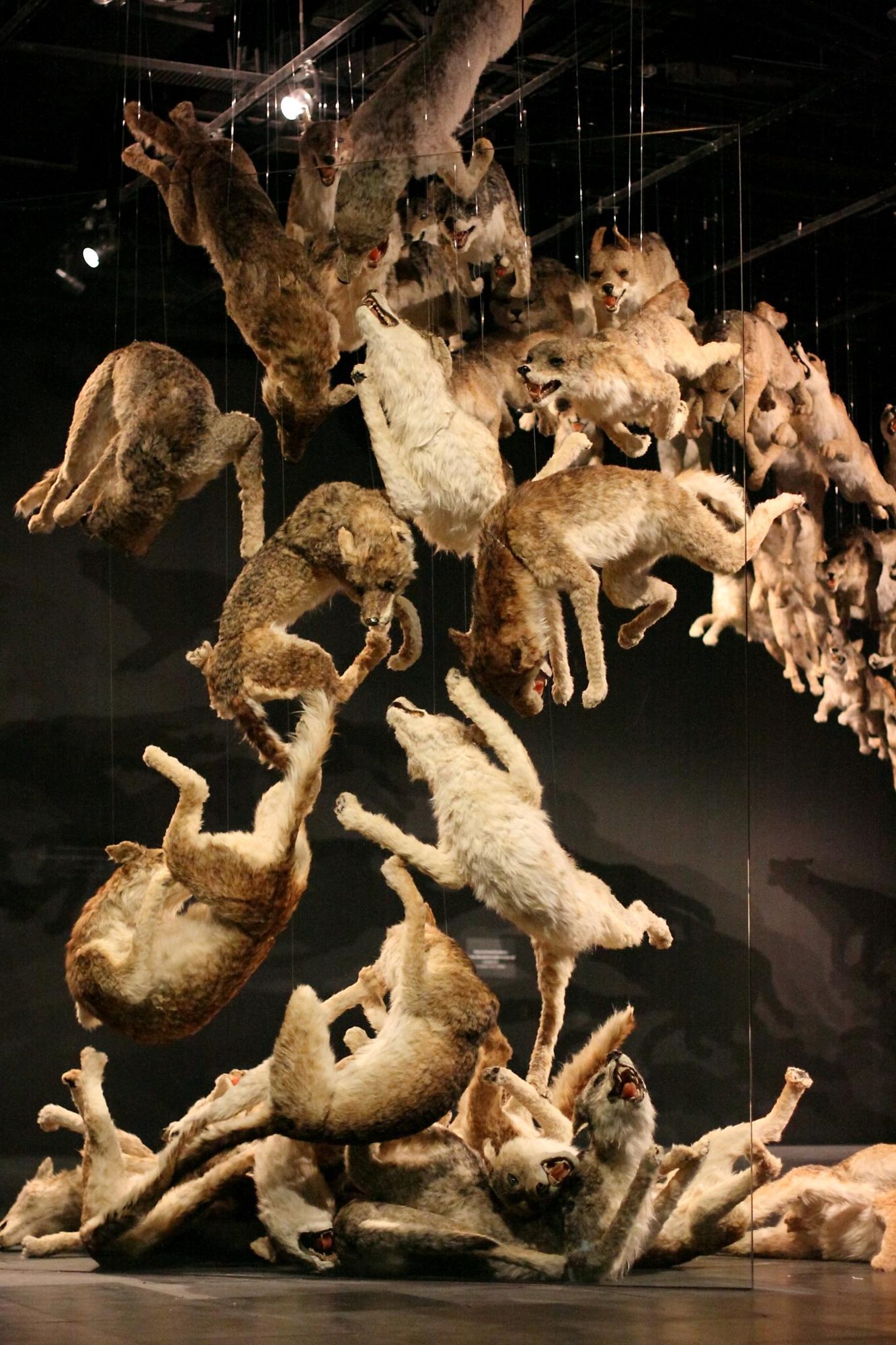
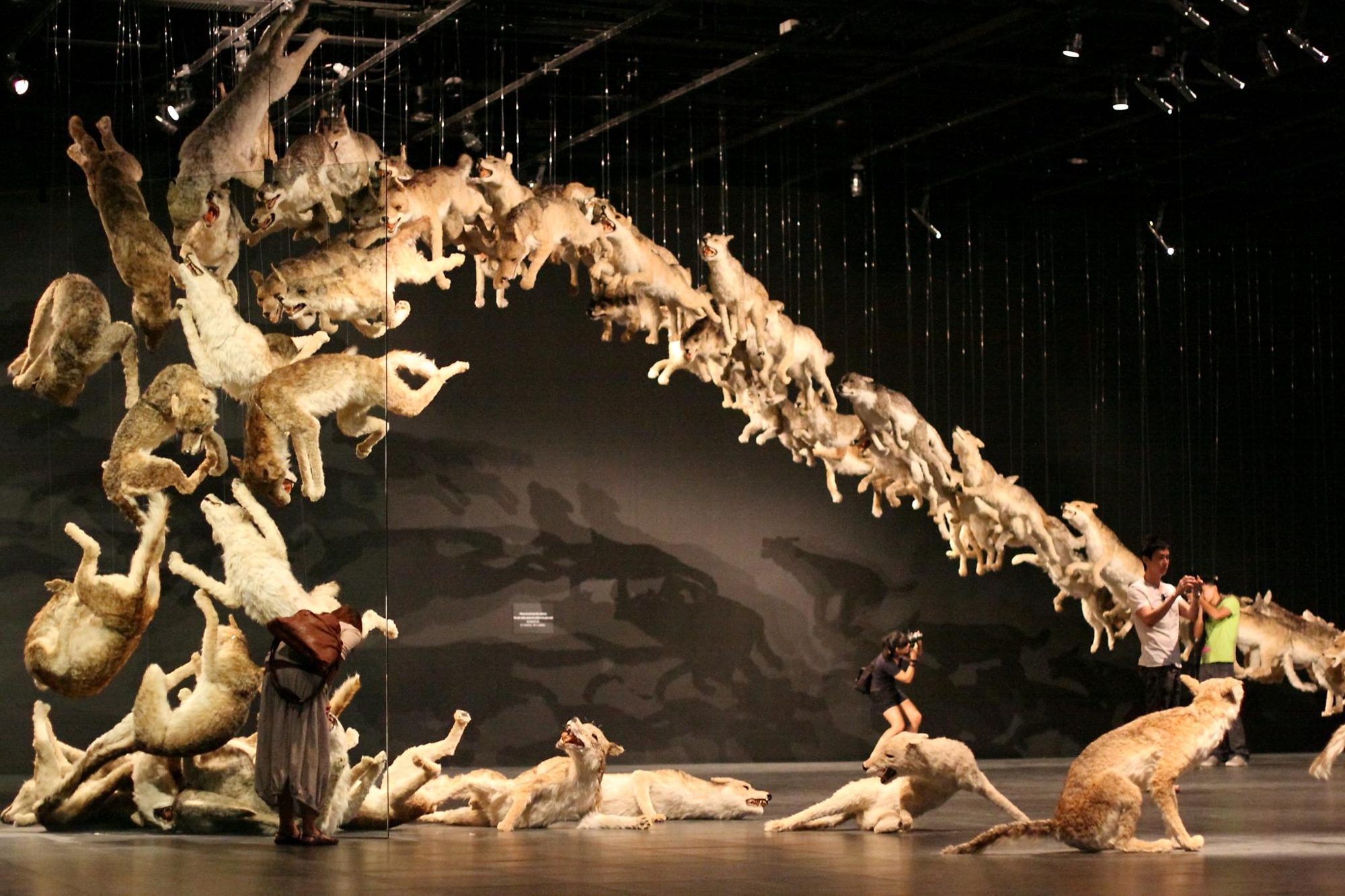
Head On, 2010 (Figure. 1), is an installation consisting of circa 99 life-size replicas of a pack of wolves and it was created by Guo-Qiang for the Deutsche Bank collection. Whilst this installation was created as a commemorative piece to Berlin’s history, Cai, adds that the work is also a portrayal of human tragedy. In this sad visual allegory, one can learn and understand that this work is a representation of Hitler and his blinded followers – following him into a path, which ultimately led them to their deaths. This subject is not obvious on a first reading of the work, however, the more one looks at it, the more one can begin to understand and associate certain historical events with that particular installation.
Cai Guo Yang is also known for his artworks produced with gunpowder and fireworks. Cai, uses visual and audio shock tactics to re-enact the popular nightmares of war, the space race, and suicide car bombings. But in portraying acts of human hatred, he offers seekers a lyrical sanctuary from violent outcomes. – (Don, J.Cohn)
Sunshine and Solitude (Figure 2), is the title of a piece created in 2010 for the Museo Universitario Arte Contemporáneo in Mexico City, which was intended to analyse the country’s landscape and the changes it went through in a particular span of time. The artwork was created using gunpowder, volcanic rocks and mezcal. The use of such materials combined with Guo-Yang’s iconic technique is a representation of creation through destruction, which is symbolical to Mexico’s instability.
After analysing the works of this artist, one can perhaps begin to understand how death and the memory can be channeled through visual means. The portrayal of death has been, and remains, a complex one; it can take on the vestiges of a symbolic or literal representation. Irrespectively, the outcome is nonetheless powerful, emotional and on occasion, sublime.
Join the Club
Like our stories?
You’ll (probably) love our newsletter.
Read more
Powered by
Publications
Social
Legal